

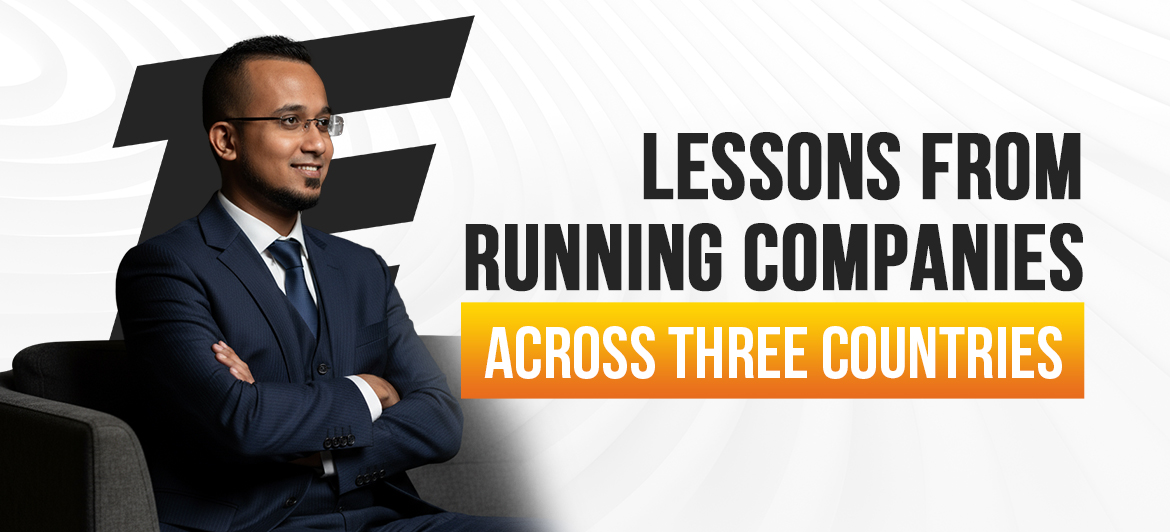
Running companies in three different countries has been one of the most rewarding and humbling experiences of my life. It sounds impressive when people hear it, but behind those words lies a story of constant learning, adjustment, and growth. The journey has been about more than just managing operations. It has been about understanding people, adapting to cultures, and building systems that can survive distance and diversity.
Each country I have operated in Bangladesh, Saudi Arabia, and Australia has its own rhythm, its own business psychology, and its own challenges. What works in one place may completely fail in another. Over the years, I have learned that success across borders requires more than money or ambition. It requires empathy, observation, and the humility to know that you do not always have the right answer.
Understanding culture before building business
One of my biggest lessons has been that culture drives business behaviour. Before you introduce a product or manage a team in a country, you must understand how people think, communicate, and make decisions. In Bangladesh, relationships come before transactions. Trust is built through personal connection, and loyalty matters more than contracts. In Australia, professionalism and structure come first. People respect transparency, efficiency, and delivery. In Saudi Arabia, patience and respect for hierarchy are essential. Timing, language, and approach mean everything.
I learned that leadership is not a one-size-fits-all skill. To lead globally, you have to be flexible. The same sentence can be taken as inspiring in one country and offensive in another. The way you give feedback, motivate teams, or negotiate deals changes depending on the environment. That realization helped me evolve from being a founder to becoming a global leader.
Building systems that outlive you
When I started managing multiple companies, I quickly realized that I could not be everywhere. My biggest challenge was letting go of control without losing quality. It took time, but I learned that the secret is in systems. Systems make a company predictable, stable, and scalable. I focused on creating clear processes, accountability frameworks, and communication channels that worked even when I was not present.
In Bangladesh, where things often move through personal networks, systems brought structure. In Australia, where everything runs on deadlines and documentation, systems kept consistency. And in Saudi Arabia, where respect and order dominate, systems created trust. No matter where you operate, systems are what transform chaos into clarity.
But systems alone are not enough. You need the right people. That brings me to another lesson talent has no nationality. I have met brilliant minds in every country I have worked in. The challenge is not finding talent; it is inspiring them to believe in a common vision. People follow direction for a while, but they follow belief forever. Once your team understands why they do what they do, you stop managing and start leading.
The power of listening
In the beginning, I used to think leadership meant giving instructions. Over time, I learned that real leadership means listening more than speaking. When you work across countries, you cannot assume that your experience in one place will apply everywhere. Listening to your team, your clients, and even your competitors teaches you more than any textbook.
In Australia, I learned from clients who demanded precision and professionalism. In Bangladesh, I learned from team members who taught me how to motivate through care and empathy. In Saudi Arabia, I learned from partners who showed me that patience is a business strategy. Listening helped me adapt and allowed people to feel heard. When people feel heard, they work harder and stay longer.
Managing time zones and trust
Running businesses across continents means your day never really ends. While Australia wakes up, Bangladesh is already working, and Saudi Arabia is finishing the day. I learned to treat time zones not as a challenge but as an advantage. I built schedules that kept projects moving 24 hours a day. When one office closed, another opened. This rhythm became a natural global engine.
But time zones also test trust. You cannot see everything, so you must trust your team. That trust does not come from micromanagement; it comes from clarity. When roles, goals, and expectations are clear, trust becomes easier. I learned that people want direction, not constant supervision. Once you give them ownership, they surprise you with how much they can achieve.
Mistakes that made me wiser
I have made my share of mistakes in every country. I once expanded too fast in Bangladesh without considering local market behaviour. I once underestimated cultural formality in Saudi Arabia. And in Australia, I once assumed that efficiency alone was enough without emotional connection. Each mistake cost me time and money, but each also gave me wisdom that no university could have taught.
The most important thing I learned from those mistakes is that failure is not a signal to stop; it is a signal to adjust. You can always rebuild, but only if you stay humble enough to learn. Every failure in one country improved my performance in another. It created resilience a kind of quiet confidence that no challenge can break.
Leadership across borders
Leading teams in different countries taught me that leadership is about energy, not presence. Your team feels your energy through your consistency, your tone, and your example. You cannot inspire people in Dhaka, Riyadh, and Sydney by simply giving orders. You must align them through purpose. That purpose must be clear, shared, and repeated until it becomes part of the company’s identity.
I learned that leadership is not about being the smartest person in the room. It is about creating a room full of smart people who trust you enough to tell you when you are wrong. That kind of culture requires humility. It requires removing ego from decision-making. Once your people realize that their voices matter, they will help you carry the vision further than you could alone.
Lessons about myself
Running companies across countries did not just teach me about business it taught me about myself. It taught me patience, self-control, and the importance of balance. It forced me to master focus because distractions were everywhere. It made me understand that no matter how global you become, your character remains your biggest currency.
When things went wrong, it was not always external problems. Sometimes it was me, my assumptions, my impatience, or my lack of delegation. Real growth came when I learned to correct myself before correcting others. I realized that the world changes quickly, and the only way to stay relevant is to stay teachable.
The value of integrity
No matter which country I worked in, integrity remained universal. You can’t buy trust; you can only earn it. Whether dealing with a student in Bangladesh, a partner in Australia, or a client in Saudi Arabia, honesty always worked. It may not give instant results, but it builds a foundation that lasts. People may forget what you say, but they never forget how you made them feel.
I also discovered that ethical leadership is contagious. When you operate transparently, your team mirrors that behaviour. That is how culture is built not through words, but through actions repeated daily.
One world, one vision
After all these years, I no longer see my companies as belonging to specific countries. I see them as part of one global ecosystem connected through purpose. The internet, technology, and human collaboration have removed borders in ways we could never imagine before. What matters now is not where you are but what you bring.
Each country still holds a special place in my heart. Bangladesh reminds me of passion and creativity. Saudi Arabia reminds me of patience and respect. Australia reminds me of precision and professionalism. Together, they make me who I am a businessman who understands that success is not about geography; it is about adaptability.
When I look back at how far we have come, I realize that the biggest lesson is simple leadership across borders is leadership across mindsets. If you can understand people, respect culture, and stay disciplined, the world will open its doors to you.
Running companies in three countries taught me that no matter how big the world seems, values still connect us all. Honesty, respect, and persistence work everywhere. That truth has kept me grounded, even as I continue to expand globally.