
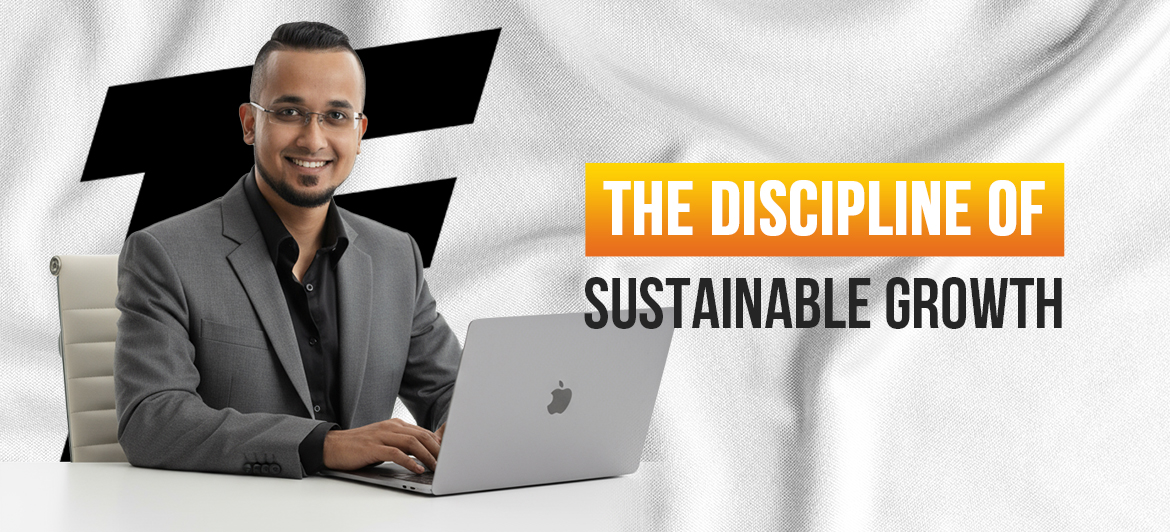
Growth is every entrepreneur’s dream, but only disciplined growth builds a legacy. I have seen companies rise fast and fall even faster, not because they lacked vision but because they lacked discipline. Growth without control is like fire without boundaries, it burns bright for a moment and then destroys everything it touches.
At TI Global, our expansion has always followed one guiding principle. Grow slow enough to stay strong and fast enough to stay relevant. It is a fine balance that requires patience, structure, and foresight. Sustainable growth is not about chasing numbers; it is about creating systems that can support those numbers. It is about building something that lasts.
Growth as a mindset, not a metric
The first lesson I learned about sustainable growth was that growth is not a destination, it is a mindset. Every decision, every hire, and every partnership must reflect that mindset. I stopped chasing size and started chasing strength.
When you measure success only by revenue, you build pressure without purpose. But when you measure success by stability and impact, you build an organization that can endure. For me, growth has always meant expansion in quality, not just in quantity. Are our people growing? Are our systems improving? Are we becoming more efficient? Those are the questions that matter.
Discipline as the foundation of growth
Discipline is the silent driver of sustainable growth. It demands consistency even when results are slow. Many businesses fail because they try to skip the invisible years. The years when effort compounds quietly without visible rewards. I respect those years because they build muscle.
When we started TI Global, I made discipline part of the culture. Every process was documented, every performance reviewed, and every lesson recorded. I taught my teams that growth doesn’t come from doing more; it comes from doing better. Sustainable success requires rhythm, not rush.
Discipline also applies to finances. Growth should never come at the cost of financial stability. I prefer calculated expansion over emotional excitement. Every new project must justify itself not only with potential revenue but with long-term sustainability. I often ask my managers, “Will this still make sense five years from now?” If the answer is uncertain, we wait.
Building on strong systems
A sustainable company is a system, not a sprint. The moment growth depends only on people instead of processes, it becomes fragile. Systems turn good performance into predictable performance. They protect the company from inconsistency and chaos.
At TI Global, we built systems for everything; client management, communication, recruitment, and reporting. These systems became the invisible infrastructure that allowed us to grow without losing control. They ensured that quality remained constant, no matter how fast we scaled.
Good systems also make leadership transferable. When your operations are defined by structure rather than individuals, you can delegate without losing direction. That is how a company grows from being personality-driven to being principle-driven.
Knowing when to say no
One of the most difficult lessons in growth is learning to say no. The world will always offer opportunities that look appealing but do not align with your long-term strategy. In the early days, I used to chase every opportunity because I was afraid to miss out. Over time, I learned that saying no to the wrong deal is just as important as saying yes to the right one.
At TI Global, we evaluate every expansion through alignment. Does this align with our mission? Does it strengthen our ecosystem? Will it enhance our reputation? If the answer to any of these is no, we pass. Focus is the currency of sustainable growth. Distraction is the cost of impatience.
Saying no also applies to people. Not every client, partner, or hire fits the company’s culture. Growth attracts attention, and attention attracts everyone. But not everyone belongs in your journey. Protecting culture is more valuable than chasing convenience.
Balancing innovation with consistency
Sustainability does not mean staying static. A company that stops innovating will eventually decline. The secret is to innovate within structure. Innovation must be intentional, not impulsive.
At TI Global, I encourage teams to experiment but within boundaries that protect our brand integrity. We explore new markets, technologies, and methods, but we do so with careful analysis. Every experiment must have a clear objective and a measurable result. Innovation without accountability leads to confusion; innovation with discipline leads to evolution.
Consistency is equally important. Clients, partners, and employees must know what to expect from you. That reliability builds trust. People don’t stay because you are exciting; they stay because you are consistent.
Building people before profit
Sustainable growth is impossible without strong people. A business can only expand as far as its people can stretch. That is why I prioritize building talent pipelines. Training, mentorship, and empowerment are not expenses, they are investments.
At TI Global, every manager has a dual responsibility to deliver results and to develop others. When leadership multiplies, scalability becomes natural. My philosophy is simple: build people, and they will build the company.
Sustainability also requires empathy. Growth should never come at the cost of burnout. I remind my team that work-life balance is not weakness; it is longevity. People who are emotionally and mentally healthy perform better, stay longer, and innovate more.
Adapting to economic realities
Every market experiences cycles of growth and contraction. A disciplined company prepares for both. During expansion, we save aggressively. During slow periods, we focus on efficiency. This rhythm keeps us balanced.
At TI Global, we operate with a long-term view. We don’t panic during downturns or overextend during booms. We analyse trends, monitor costs, and diversify revenue streams. That is why we operate across multiple sectors like education, technology, aged care, and real estate. Each one supports the other. When one slows, another rises. Diversification is not just a growth strategy; it is a survival mechanism.
Measuring what truly matters
Growth is not always visible in spreadsheets. Some of the most important forms of growth are intangible reputation, culture, relationships, and trust. These take years to build but can be destroyed in a moment of carelessness.
That is why I treat every decision as a reflection of our brand. I often tell my managers that sustainable growth means doing the right thing even when it is slower. Fast profits fade; honest progress lasts.
I also measure growth by resilience. How quickly can we recover from a setback? How well can our systems absorb shocks? Those questions reveal a company’s true strength.
Patience as a business strategy
In a world obsessed with speed, patience has become a competitive advantage. I have learned that steady growth compounds in ways rapid growth never can. When you grow too fast, you skip the lessons that make you wiser. When you grow at the right pace, every milestone prepares you for the next one.
Patience is not inactivity; it is intelligent timing. It means knowing when to act and when to wait. The greatest achievements in business often come from those who waited for the right moment instead of forcing the wrong one.
Final reflection
Sustainable growth is not a phase; it is a philosophy. It demands discipline, clarity, and restraint. It is about saying no more often than you say yes, about improving quietly instead of expanding recklessly.
At TI Global, I measure success not by how many new ventures we launch but by how strong each venture becomes. The goal is to build a company that can stand tall in any storm — because it was built on patience, structure, and purpose.
The discipline of sustainable growth is not glamorous. It is slow, steady, and often invisible. But it is the kind of growth that lasts. And in business, lasting is everything.